
Professor of Physics
Office: 5111 Broida
Hall
Phone: (805) 893-8408
Fax:
(805) 893-8597
Email: jdrichman ---at--- ucsb.edu
Mail:
Physics Department
University of California
Santa Barbara, CA 93106-9530
Jeffrey Richman - short biographical sketch
Teaching and teaching evaluations
My research is in experimental elementary particle physics, the exploration of the fundamental constituents of matter and their interactions. I work on the CMS experiment at CERN Large Hadron Collider (LHC), mainly on studies of the Higgs boson, searches for supersymmetry (SUSY) and other new physics, and on electronics for the CMS muon system. Currently, my group is working on searches for Higgsinos and rare Higgs decay modes, and we are building new high speed opto-electronics boards for the CMS Cathode-Strip Muon System. I have also worked for many years on heavy-quark physics, most recently on the BaBar experiment at Stanford Linear Accelerator Center (SLAC).I encourage inquiries from graduate students interested in working on CMS. Just send me an e-mail, call, or stop by my office. Undergraduates interested in working in my group need to take Ph 125 and Ph 115 abc first.
The CMS experiment is an exciting project to explore physics at the TeV energy scale, where new kinds of phenomena are expected to appear. We are exploring the mechanism of electroweak symmetry breaking, which endows many particles with masses, and searching for particles that could make up the dark matter inferred from astrophysical observations.
I am currently working on searches for supersymmetric particles in leptonic and all-hadronic final states and in final states with higgs bosons. My group was heavily involved in the CMS Muon High Level Trigger and in electronics development for the CMS muon CSC (cathode-strip chambers) system. We are now working on a major upgrade to the CSC electronics. I have been co-convener of the CMS Supersymmetry (SUSY) physics analysis group and co-chair of both the Exotica and SUSY Publications Boards.
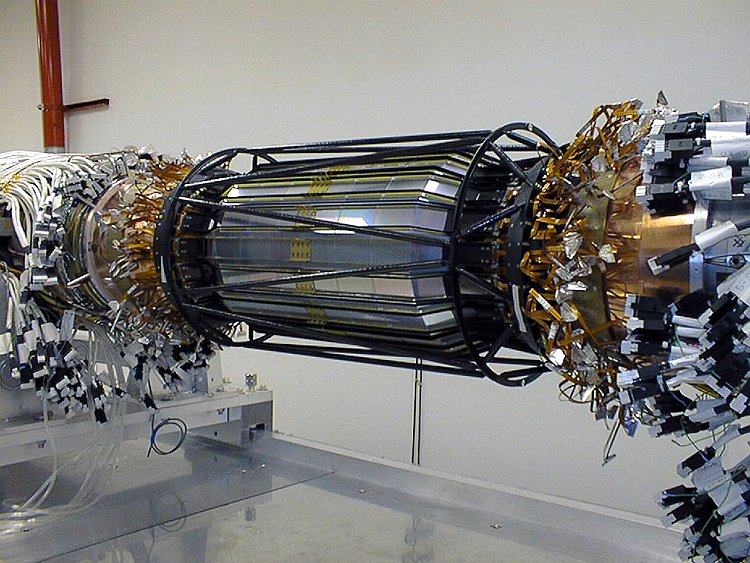
In BaBar I worked on the construction of the Silicon Vertex Tracker (SVT) and on the analysis of rare B meson decays. I was Physics Analysis Coordinator of BaBar in 2003-2004 and Deputy Physics Analysis Coordinator in 2002-2003.
The papers and talks listed below give more information on these and other topics.
Teaching
- Search for supersymmetry in pp collisions at sqrt(s)-13 TeV with 137 fb^{-1} in final states with a single lepton using the sum of masses of large-radius jets, Phys. Rev. D 101, 052010 (2020).
- Search for supersymmetry in proton-proton collisions at 13 TeV in final states with jets and missing transverse momentum, Journal of High Energy Physics 10, 244 (2019).
- Progress and Puzzles at the TeV scale: Recent results from the CMS experiment at the Large Hadron Collider . Talk at the University of Pittsburgh Physics Department, Pittsburgh, PA, November 19, 2018.
- Search for higgsino pair production in pp collisions at sqrt(s) = 13 TeV in final states with large missing transverse momentum and two Higgs bosons decaying via H to bb-bar , Phys. Rev. D 97, 032007 (2018).
- Search for supersymmetry in pp collisions at sqrt(s) = 13 TeV in the single-lepton final state using the sum of masses of large-radius jets, Phys. Rev. Lett. 119, 151802 (2017).
- Search for supersymmetry in multijet events with missing transverse momentum in proton-proton collisions at 13 TeV, Phys. Rev. D 96, 032003 (2017).
- Searching for Supersymmetry at the LHC. Seminar at the Karlsruhe Institute of Technology, Karlsruhe, Germany, June 29, 2017.
- Searching for Supersymmetry in LHC Run 2 and Beyond. Seminar at the Mitchell Institute, Texas A&M University, March 31, 2016.
- Search for supersymmetry in pp collisions at sqrt(s) = 13 TeV in the single-lepton final state using the sum of masses of large-radius jets , J. High Energy Phys. 08 (2016) 122.
- Search for supersymmetry in the multijet and missing transverse momentum final state in pp collisions at 13 TeV , Phys. Lett. B 758 (2016) 152.
- Prospects for SUSY and BSM Physics at the High Luminosity LHC. Talk at the 3rd Conference on Large Hadron Collider Physics (LHCP), St. Petersburg, Russia, September 3, 2015.
- Searches for electroweak neutralino and chargino production in channels with Higgs, Z, and W bosons in pp collisions at 8 TeV , Phys. Rev. D 90 (2014) 092007.
- Searching for Supersymmetry at the LHC. Colloquium given at Department of Physics & Astronomy of the University New Mexico, Albuquerque, Nov 7, 2014 (powerpoint version). pdf version
- Searching for Supersymmetry at the LHC. Seminar given at the Department of Physics & Astronomy of the University of New Mexico, Albuquerque, Nov 6, 2014 (powerpoint version). pdf version
- Searches for Supersymmetry in the CMS Experiment. Plenary session talk at the SUSY 2013 Conference, Trieste, Italy, Aug 26-31, 2013 (powerpoint version). pdf version
- From the Big Bang to the Higgs Boson in Less than an Hour. Talk on LHC physics at the Humanist Society of Santa Barbara, Aug 17, 2013 (powerpoint version). pdf version
- From the Big Bang to the Higgs Boson in Less than an Hour. Talk on LHC physics in the Groundbreaking Research/Innovative Technology series at UCSB, July 1, 2013 (powerpoint version). pdf version
- The Discovery of a New Particle at the Large Hadron Collider (powerpoint version) Talk on the discovery of the/a Higgs-boson-like particle for the UCSB MLPS Dean's Cabinet, March 14, 2013. pdf version
- From the Big Bang to the Higgs Boson in Less than an Hour. Talk at the Chancellor's Community Breakfast, November 8, 2012.
- 69th Scottish Universities Summer School in Physics, St. Andrews 19th August - 1st September 2012> (home page) See also Timetable.
- Searches for New Physics at the Large Hadron Collider, writeup of lectures at the Scottish Universities Summer School in Physics, St. Andrews, 19 August - 1 Sept 2012.
- Searches for New Physics at the Large Hadron Collider, Lecture 1. Lecture at the Scottish Universities Summer School in Physics, St. Andrews, 19 August - 1 Sept 2012. .pptx file
- Searches for New Physics at the Large Hadron Collider, Lecture 2. Lecture at the Scottish Universities Summer School in Physics, St. Andrews, 19 August - 1 Sept 2012. .pptx file
- Searches for New Physics at the Large Hadron Collider, Lecture 3. Lecture at the Scottish Universities Summer School in Physics, St. Andrews, 19 August - 1 Sept 2012. .pptx file
- "Higgs in Hollywood": a Higgs boson, a Z-boson, and a neutralino walk into a bar. A skit that I wrote for the banquet at the Scottish Universities Summer School in Physics, St. Andrews, 19 August - 1 Sept 2012.
- UCSB press release on the observation of a particle consistent with the Higgs boson.
- Searches for supersymmetry from the CMS experiment, Talk at the West Coast LHC Theory Meeting, Kavli Institute for Theoretical Physics, UCSB, 15 April 2011.
- Exploring the TeV Scale at the Large Hadron Collider, Colloquium at the University of California, Riverside, Physics Department, 7 April 2011.
- Exploring the TeV Scale at the Large Hadron Collider, Colloquium at Stanford Physics Department, 16 Nov 2010.
- Early Results and Physics Prospects from the CMS Experiment at the LHC, talk at the Kavli Institute for Theoretical Physics, UCSB, 7 May 2010.
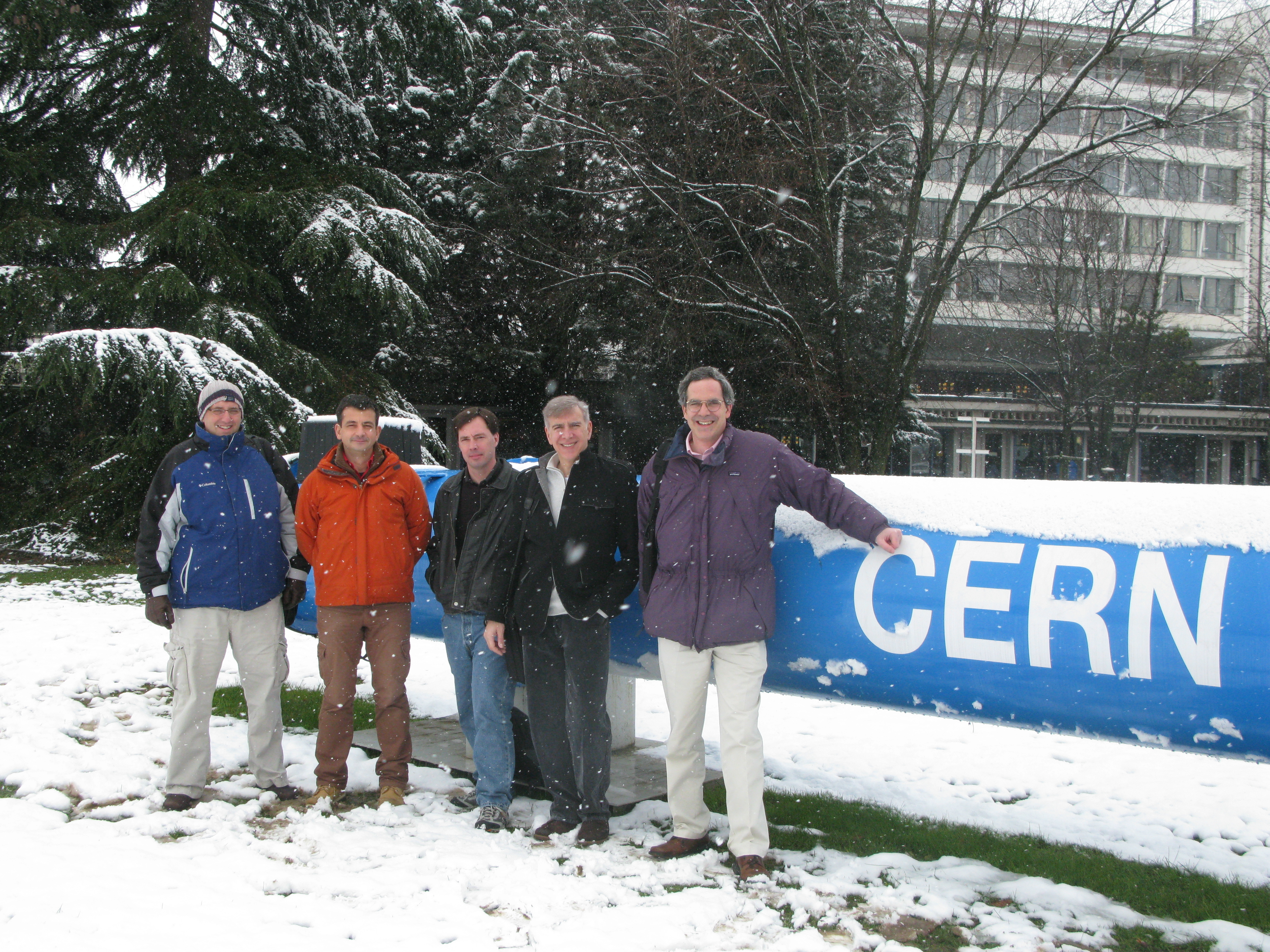
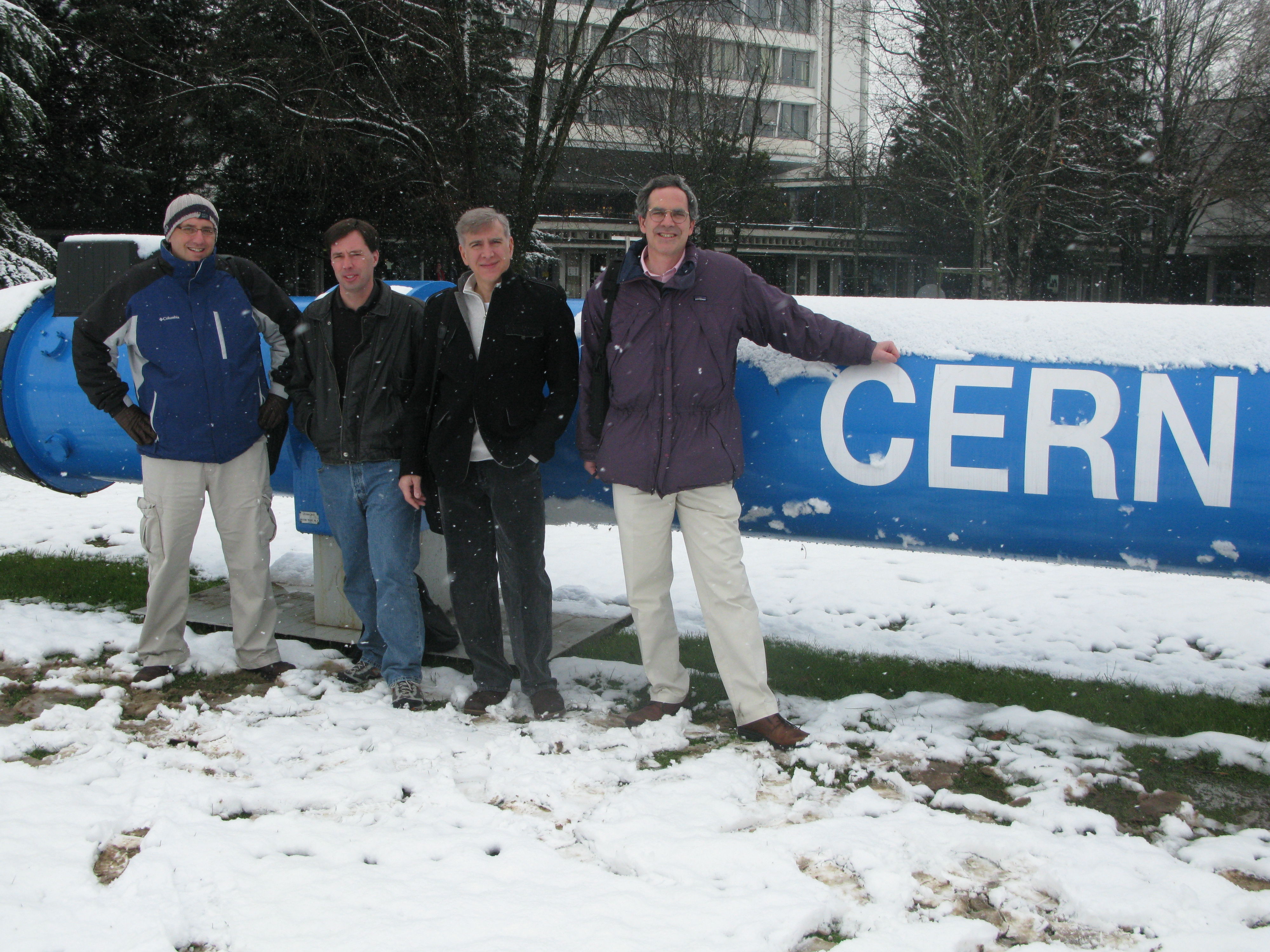
- Photograph (jpg) of (left to right) Claudio Campagnari, Guido Magazzu, David Stuart, Joe Incandela, and Jeff Richman at CERN, with an LHC dipole magnet on display outside CERN Restaurant 1 (11 December 2008). Photograph (jpg) of (left to right) Claudio Campagnari, David Stuart, Joe Incandela, and Jeff Richman.
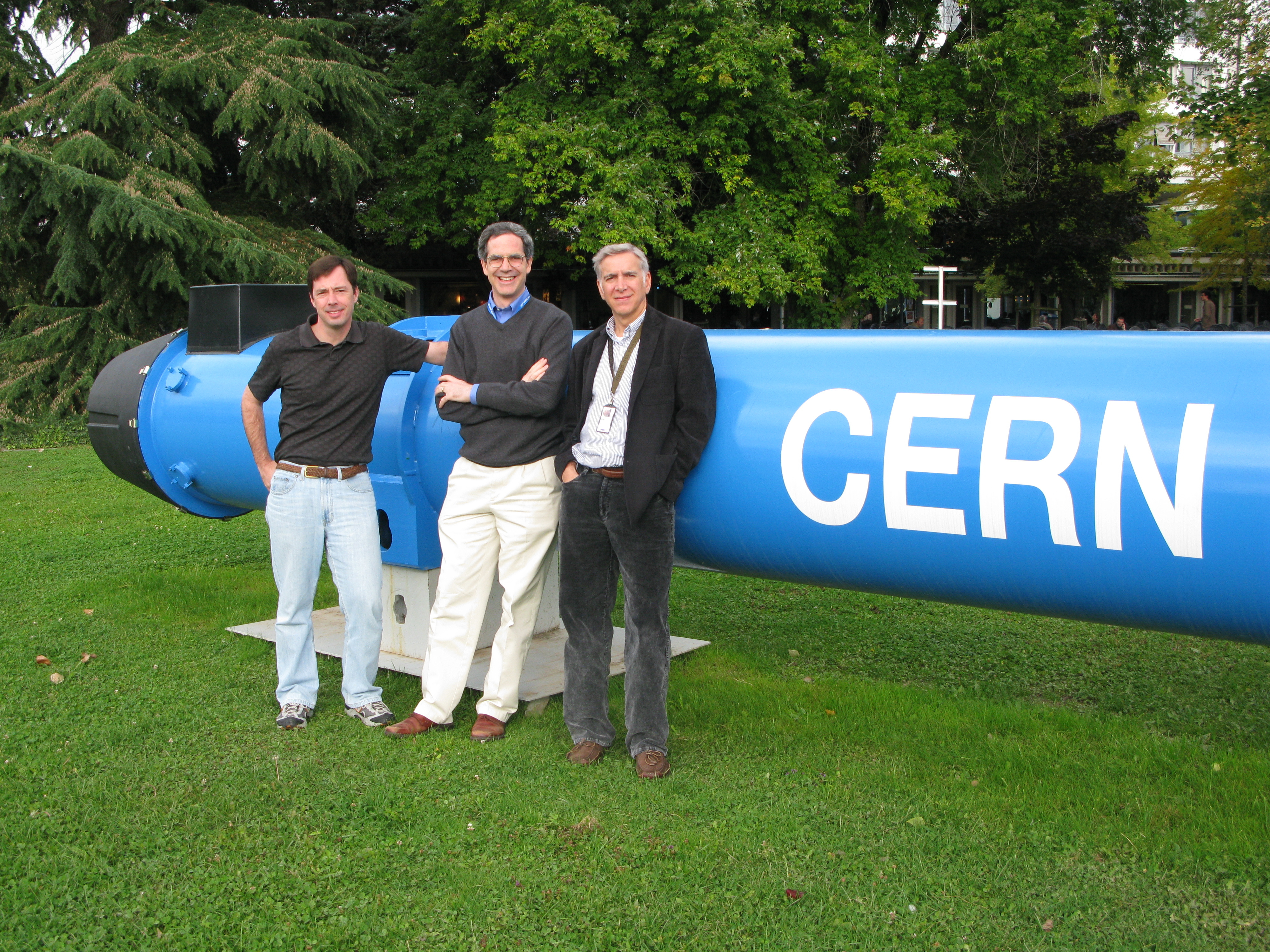
- Photograph (jpg) of David Stuart (left), Jeff Richman (middle), and Joe Incandela (right) at CERN, with an LHC dipole magnet on display outside CERN Restaurant 1 (fall 2008).
- Radio interview (mp3) of Jeff Richman and Mike Witherell on the LHC and its physics goals. Interview by Lance Orozco from KCLU, one of our local NPR stations (12 Sept, 2008).
- UCSB Press Release on our LHC Group. (10 Sept, 2008).
- Lecture 1, Lecture 2, and Lecture 3, of ``CP Violation and Heavy-Quark Physics'' (Lectures given at the XIII Mexican School of Particles and Fields , Oct 2--11, 2008)
- ``The Discovery and Study of B Mesons in the CLEO Experiment'' (ppt file) and (pdf) talk at the Symposium Celebrating CLEO and CESR, 31 May 2008.
- Lecture 1 and Lecture 2. of ``Things I wish I'd known when I was a graduate student...that are related to particle physics'' (Lectures given at the BaBar Physics Analysis School), Feb 19--23, 2008
- Observation of the semileptonic decays B->D* tau anti-nu (tau) and evidence for B-> D tau- anti-nu(tau). . Published in Phys.Rev.Lett. 100:021801, 2008. This paper is part of the Ph.D. thesis work of my former student Michael Mazur.
- Study of Exclusive Semileptonic B Meson Decays to Tau Leptons. Ph.D. thesis of my former student Michael Mazur, now a postdoc at University of Freiburg on the ATLAS experiment.
- Integrity of Data Samples and Results in High Energy Physics, Presentation to the National Academies Committee on Assuring the Utility and Integrity of Research Data in the Digital Era, Irvine, California, September 17, 2007
- Measurement of the branching fractions for B -> D tau nubar and B -> D* tau nubar. (Paper submitted to the European Physical Society Conference, EPS2007). This paper reports the first evidence for the decay B0bar -> D+ tau- nutaubar and the first observation of the decays B- -> D*0 tau- nutaubar. It is part of the Ph.D. thesis work of my former student Michael Mazur.
- Thoughts on the DOE University Program in High Energy Physics , Presentation to the HEPAP Subpanel on the University Grants Program in High Energy Physics, SLAC, January 2007
- Radiative and Electroweak Penguin Decays of B Mesons, Talk presented at the 11th International Conference on B Physics at Hadron Colliders, Oxford University, September 2006
- A Particle Physics Tour with CompHEP, a practical guide to CompHEP, a tool for evaluating Feynman diagrams for many different processes.
- Measurement of the branching fractions, rate asymmetries, and angular distributions in the rare decays B -> K l+l- and B -> K* l+ l-. (Phys. Rev. D73 (2006) 092001) The work for this paper was led by my postdoc Jeff Berryhill, who is now a Wilson Fellow at Fermilab. (Our other B->K(*)l+l- measurements are listed below.)
- Rare and Semileptonic Decays of B and K Mesons, Plenary session talk at the Particles and Nuclei International Conference, Santa Fe, October 2005
- My talk to the Particle Physics Project Prioritization Panel (P5), October 2005
- Realms of Exploration and Discovery in B Physics, A series of lectures on B physics that I gave at the Chinese Institute of High Energy Physics summer school in summer 2005.
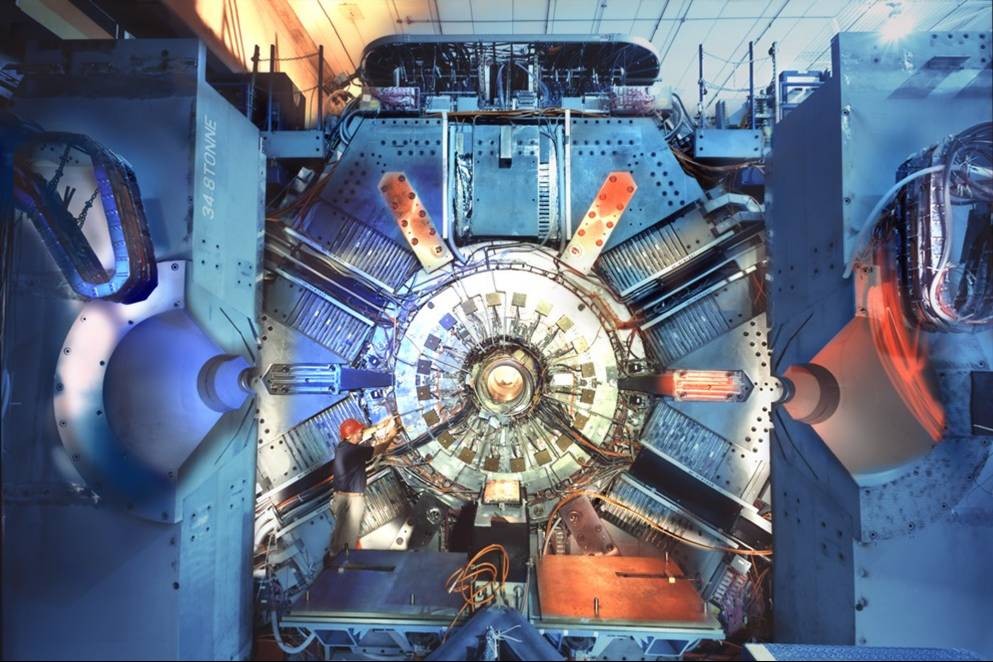
- Photograph of the BaBar Detector, courtesy of Peter Ginter/SLAC.
- CMS experiment home page
- BaBar home page (for physicists)
- BaBar public page
- Matter-Antimatter Asymmetries: What have we learned?, a colloquium that I gave at MIT on BaBar on May 5, 2005.
- BaBar results from summer 2004, near the end of my term as Physics Analysis Coordinator.
- Photograph of the BaBar Silicon Vertex Tracker before installation (.jpg)
- Another nice photograph of the BaBar SVT before installation (.ps)
- Evidence for the Rare Decay B->K*l+l- and Measurement of the B->Kl+l- Branching Fraction (pdf) . Members of our group, including Jeffrey Berryhill (postdoc) and Natalia Kuznetsova (graduate student), contributed heavily to this work, which was published in Physical Review Letters (Phys.Rev.Lett.91:221802,2003). Natalia is now an Assistant Professor at Hamilton College.
- Writeup of plenary talk on "Progress on Heavy-Quark Physics from BaBar, Belle, and CLEO" (for Proceedings of Conference on the Intersections of Particle and Nuclear Physics, Quebec, May 2000.)
- Transparencies of plenary talk in Quebec on "Progress on Heavy-Quark Physics from BaBar, Belle, and CLEO"
- My talk about the UCSB HEP group at the HEPAP meeting at UCLA (July 2000).
- Web page for CLEO measurement of B->rho l nu. This analysis is part of the completed thesis work of one of my students, David Lange. David is now a staff scientist at Lawrence Livermore National Laboratory.
- Preprint of new CLEO II PRD paper on B->rho l nu and Vub.
- Les Houches Lectures on Heavy-Quark Physics and CP Violation : these lectures are meant for graduate students and postdocs interested in heavy-quark physics.
- The BaBar Silicon Vertex Tracker : J.D. Richman, NIM A 409, 219 (1998). A short article on the new vertex detector.
- Leptonic and Semileptonic Decays of Charm and Bottom Hadrons : J.D. Richman and P.R. Burchat, Rev. Mod. Phys. 67, 893 (1995). A comprehensive discussion of these decay modes.
- Anders Ryd's thesis: ``Measurement of B Meson Semileptonic Decay Form Factors.'' Anders is currently Assistant Professor at Cornell University.
- Measurement of the Form Factors for B->D^* l nu : (CLEO Collab., J.E. Duboscq et al., Phys. Rev. Lett. 76, 3898 (1996)). This measurement is part of the completed thesis work of one of my students, Anders Ryd.
- Progress in Understanding Heavy Flavor Decays : J.D. Richman, plenary talk given at the International Conference on High Energy Physics, Warsaw, 1996.
- An Experimenter's Guide to the Helicity Formalism. A pedagogical description of the helicity formalism, which I wrote as a graduate student. Useful for calculating decay angular distributions.
Rate overall quality of instructor's teaching. (Averaged over students, scale 1-5, 1 is best.)Physics and math videos
Ph 225a, Elementary Particle Physics (grad), Fall 2014, Teaching eval = 1.0 Ph 225b, Elementary Particle Physics (grad), Winter 2014, Teaching eval = 1.5 Ph 225a, Elementary Particle Physics (grad), Fall 2013, Teaching eval = 1.4 Ph 225b, Elementary Particle Physics (grad), Winter 2013, Teaching eval = 1.0 Ph 225a, Elementary Particle Physics (grad), Fall 2012, Teaching eval = 1.0 Ph 125, Elementary Particle Physics (undergrad), Spring 2012, Teaching eval = 1.3 Ph 4, Introductory Electromagnetism and Optics (undergrad), Spring 2012, Teaching eval = 1.6 Ph 225b, Elementary Particle Physics (grad), Winter 2012, Teaching eval = 1.0 Ph 125, Elementary Particle Physics (undergrad), Spring 2011, Teaching eval = 1.8 Ph 4, Introductory Electromagnetism and Optics (undergrad), Winter 2011 Teaching eval = 1.8 Ph 125, Elementary Particle Physics (undergrad), Spring 2008 Teaching eval = 1.2 Ph 119, Thermal Physics (undergrad), Fall 2007, Teaching eval = 2.1 Ph 125, Elementary Particle Physics (undergrad), Spring 2007, Teaching eval = 1.3 Ph 4, Introductory Electromagnetism and Optics (undergrad), Winter 2007, Teaching eval = 2.0